The Brazil Post
Brazilian Postal History
Postal History
Colonial Period
King João VI's ruling and the United Kingdom
Imperial Period
Republican Period
DCT Period
Correios period
Postal History
The course of Postal History corresponds to the historical transformation of the country itself, which is why the knowledge of key facts related to the implementation and improvement of postal services provides an overview of the historical development of Brazil.
From the beginning of postal services to date, Correios assumed its position as a link that brings people closer together and as a respectable institution, which has always sought to adapt to the various periods of progress in Brazil, by promoting the continuous improvement of the services and products it offers society.
Colonial Period
With the arrival of Pedro Álvares Cabral to Brazil in 1500 came the first official correspondence related to the country, written by Pero Vaz de Caminha and sent to the King of Portugal, reporting with evident enthusiasm the unveiling of a new land. With this event, immortalized in Brazilian history, the first page of the history of postal services in Brazil was written.
The dawning of postal services in colonial Brazil refers to Portugal's Post and its role in this new territory. During the early days of colonization, the Portuguese did not have a well-organized postal system, and they even had to resort to neighboring nations.
Not even the creation of the “Correio-Mor das Cartas do Mar” (an Overseas Postal Service), in 1673, solved the problem of postal connection between the new world and the metropolis. Thus, the difficulty in communications between Portugal and its Colony, Brazil, encouraged them to officially establish the Maritime Postal Services. Years later came the need to promote the expansion of these services to the interior of the Colony.
The arrival of the Royal Family to the New World opened up ways for the Postal Service to develop further, alongside the commercial progress, with the elaboration of the first Postal Regulation in Brazil, the regular operation of Postal Services by Sea, and by issuing new decrees which created the Inland Post Office Services.
With the return of D. João VI to Portugal, there was a very troubled period that culminated in the independence of the country in 1822 when Correios played an important role by bringing information from the Old World and in the gathering of forces for the rupture with Portugal.
1500
Written by Pero Vaz de Caminha, a letter to the King of Portugal, narrating the characteristics of the newly discovered land, known as Caminha's Letter, considered to be the birth certificate of Brazil, being the first official document about the country. Currently, the document is kept at the Tower of Tombo in Lisbon, Portugal.
1520
Luiz Homem, through the Charter of November 6, received from King D. Manuel I the privilege of operating the postal service in Portugal, having been appointed to the position of the first Postal Chief (the head of the postal system) of the Kingdom (1520/1532).
1532
With the death of Luiz Homem, Luiz Afonso was appointed to the position of second Postal Chief of the Kingdom (1532/1575). In Brazil the village that would originate the city of São Vicente, in the state of São Paulo, was founded.
1534
The King D. João III instituted in the areas of Brazil, the system of Hereditary Captaincies, establishing boundaries, jurisdictions, and stimulating the emergence of the first settlements, stimulating the creation of cities such as Olinda in the state of Pernambuco, Ilhéus and Porto Seguro in Bahia, Vila Velha in Espírito Santo, Santo André in São Paulo, and Angra dos Reis in Rio de Janeiro.
1548
D. João III established on December 17, Brazil's General Government, based on the Captaincy of Bahia, as it was known then.
1549
Headquartered in Salvador, Bahia, the first General Government of Brazil had Tomé de Souza as its Governor. Salvador became thus the first capital of the country.
1554
On January 25, the Jesuits founded the São Paulo College, where the city of São Paulo would later be located.
1565
Estácio de Sá, Mem de Sá’s nephew, third Governor-General of Brazil (1557/1572), founded on March 1st, the city of São Sebastião do Rio de Janeiro, which would later become the second capital of the country.
1573
The King D. Sebastião divided Brazil into two governments: the North government, based in Salvador, and the South government, based in Rio de Janeiro; this division lasted until 1577, when the two merged into one government headquartered in Bahia.
1575
The King D. Sebastião named Francisco Coelho, through a letter dated September 20, the third Postal Chief of the Kingdom (1575/1579).
1579
With the death of Francisco Coelho, Manoel de Gouvea, his son-in-law, as provided in the Royal Charter of July 27, was appointed the fourth Postal Chief (1579/1598).
1606
After the death of Manoel de Gouvea (1598), the position of fifth Postal Chief (1606/1607), as provided by the Charter written on July 19, was granted (in this case, sold) by King Philip III of Spain and also II of Portugal to Luiz Gomes da Matta, after a lapse of eight years in which there was no license to operate the service.
1607
The position of sixth Postal Chief of the Kingdom (1607/1641) was transferred to Antonio Gomes da Matta, Luiz Gomes da Matta’s son.
1663
On January 25, the date of the nomination of Lieutenant João Cavalheiro Cardozo to the position of Postal Chief of the Captaincy of Rio de Janeiro – when the position of Postal Chief first appeared in Brazil – is considered to be the starting date of the institution of a regular postal activity in the country. This nomination was made by the seventh Postal Chief of the Kingdom (1641/1674) and the first Postal Chief of Letters by Sea, Luiz Gomes Neto da Matta. For this reason, on January 25, we celebrate the “Day of the Postman.”
1669
Bartholomew Fragoso Cabral was appointed Postal Chief of the Captaincy of Bahia on May 15 by Luiz Gomes Neto da Matta.
1674
Duarte de Souza Coutinho da Matta, Luiz Gomes Neto da Matta’s son, was appointed the eighth Postal Chief of the Kingdom (1674/1696) and Postal Chief of Letters by Sea, including to Brazil, as per the Royal Charter of February 23, 1962.
1696
Luiz Victório de Souza Coutinho da Matta, Duarte de Souza Coutinho da Matta’s son, was appointed the ninth Postal Chief (1696/1735). D. Izabel Cafaro, his mother and tutor, was initially in charge of the postal services since he was not old enough at the time – for inheritance purposes, the minimum age was 25. D. Izabel Cafaro was thus the first woman to manage postal services that comprised Brazil.
1710
Antônio Alves da Costa was appointed Postal Chief of the Captaincy of Rio de Janeiro.
1735
Jose Antonio de Souza Coutinho da Matta, Luis Victorio’s son, was appointed to the position of tenth Postal Chief of the Kingdom (1735/1790); his uncle Thomas Cafaro was responsible for the administration of Correios until he reached the age of 25.
1773
On September 1, the first inland postal communication between São Paulo and Rio de Janeiro was established, a messenger service created by the governor of the Captaincy of São Paulo and Morgado de São Mateus, D. Luis de Sousa Botelho Mourão.
1790
The 11th and last Postal Chief was appointed (1790/1801), Manuel José da Maternidade de Souza Coutinho da Matta, José Antônio’s son; his uncle Duarte de Souza Coutinho was responsible for the administration of Correios, until he reached the age of 25.
1797
The position of Postal Chief of the Kingdom and domains was terminated and reinstated to the Crown by a Decree issued on March 16. With the appointment of D. Rodrigo de Souza Coutinho to the position of State Minister of Marine and Colonies, the State realized it should claim to the Crown the Administration of the Postal Services, and as a result the first Director of Correios, Luis Pinto de Souza was vested in the position.
1798
By a Decree of January 20, 1798, the process of organizing land postal services was commenced, and a regular shipping connection was established between Brazil and Portugal (Lisbon and Rio de Janeiro, initially).
A Post Office Administration was installed in Rio de Janeiro, which operated in the Royal Palace near the premises of the Court of Appeals and the Mint, where the letters that arrived from Portugal were distributed, having Antonio Rodrigues da Silva as its first administrator.
The internal postal service was regulated, which began with the creation of the first Brazilian post office in the countryside, in Campos-RJ.
1799
On April 1, the Provisional Rules for the new establishment of the new Post Office, with land and overseas administrations.
The calculation of portages was based on the weight of the correspondence and the distance traveled to make the delivery.
1801
Creation, in Rio de Janeiro, of post office boxes' service and the institution of the service of inland Registered Mail.
1805
Promulgation in Lisbon, on April 8, of the decree that established the “New Mail Regulation” for Portugal and colonies.
King João VI's ruling and the United Kingdom
Prince D. João, ruler of Portugal, due to his mother's lack of mental capacity, D. Mary I, was forced to move to Brazil with the whole court, because of the Napoleonic Wars. During the time he was here (1808-1821) he made Brazil the Lusitanian seat of the monarchy and established inland post offices in Brazil and their connection with the Rio de Janeiro.
1808
The Portuguese royal family, accompanied by a great retinue, arrived in Brazil on March 7, and the country left the condition of colony to become the seat of the Portuguese government, located in Rio de Janeiro.
In July, the link between England and Brazil by sea was established. The departure on the 14th of that month took place at the Port of Falmouth bound for Rio de Janeiro, passing by the Island of Madeira, by Pernambuco and Bahia. At the time, the ship Walsingham was commanded by Captain Roberts. This meant that Brazil would replace the Sea Mail service with England, which until then was made with Lisbon, in view of the temporary suspension caused by the invasion of Portugal by Napoleon Bonaparte's troops.
The Provisional Regulation, of the General Administration of the Mail of the Crown and the Province of Rio de Janeiro, Brazil's first Postal Regulation, was established on November 22, by D. Fernando José de Portugal, Marquis of Aguiar.
1812
On September 23, a Notice was issued setting carriage fees and determining the appointment of post office agents in Brazil.
1813
Establishment of inland Post Offices in the states of Bahia and Maranhão, on June 28.
1815
On December 16, Brazil was raised to the condition of United Kingdom with Portugal and the Algarve.
1817
A regular mail between São Paulo and Rio Grande do Sul run by the military José Pedro Cesar was created.
1818
The acclamation of D. João VI on February 6.
Imperial Period
During this period, D. Pedro I reorganized the Post Offices in the independent Brazil and began the process of creating postal administrations in the provinces.
Under the rule of D. Pedro II, the postal reforms instituted: the prior payment of a unified franchise; the launching of the first postage stamps; the creation of a staff of postmen, of pick up and postal boxes, and home delivery of mail in the Court and in the provinces. Telegraph services were established and, through treaties, Brazil joined international telecommunications organizations that had just been created.
1822
The messenger Paulo Bregaro, considered to be the first postman and Patron of all Postmen in Brazil, delivered to D. Pedro I, on September 7, on the banks of the Ipiranga River, a correspondence from the Empress Leopoldina reporting on the new demands from Portugal to Brazil. When he received it, D. Pedro responded to the impositions of the Court, by declaring the Independence of Brazil, thus associating Correios to this important historical moment in the country.
1828
José Clemente Pereira, Minister and Secretary of Empire Affairs, presented the proposal of reorganization of the postal services, formalized by the Decree of September 30.
1829
In addition to the Decree of the previous year, D. Pedro I, determined by the Decree of March 5, the unification of all the existing postal lines at that time in a general administration, the “Administration of Correios” and the creation of provincial administrations in the capitals of the provinces.
1831
Elimination of the position of Director General of Correios (DGC), the minister of the empire being responsible for the direction and inspection thereof, at the Court; and the chairmen would respond for the provinces.
1835
Adoption of home delivery of mail; the use of uniform with mail bags to distribute and another one to pick up letters from passers-by.
1840
Rowland Hill created in England the first adhesive postage stamp, the Penny Black, as part of the English Postal Reform, the payment of the correspondence was going to be carried out by the sender and not by the recipient, as it was until then, the stamp served as proof of such a payment.
1841
Beginning of the Second Empire with the crowning of King D. Pedro II on July 17, 1841.
1842
Postal reform in the English fashion, to prior payment of the fee, with the adoption of a postage stamp.
1843
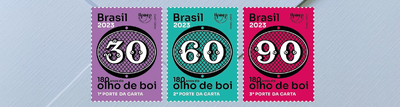
On August 1, the first Brazilian postage stamps (called Olhos-de-Boi, Ox's Eyes) were issued at the values of 30, 60 and 90 réis. For this reason, on this day we celebrate the “Day of the Stamp” in Brazil.
1844
Creation of the position of postmen and bags carriers, as well as the system of home delivery of mail.
1845
Installation of the first Pick up Boxes of the Empire in Rio de Janeiro. A new issue of stamps called “Slanted” was released.
1852
Installation of the electric telegraph in Brazil. The first official link was seen between the Headquarters of the Army, in Rio de Janeiro, and the imperial residence at the Quinta da Boa Vista.
1861
Creation of the Secretariat of State for Agricultural Affairs, Commerce and Public Constructions, to which land and sea post offices were linked. Conventions were enacted providing for the exchange of mail with foreign states.
1865
The Postal Voucher Service was implemented.
1866
Stamps began to bear the effigy of King D. Pedro II and, from then on, they started to be perforated.
1872
The first illustrated postcards were issued.
1877
Brazil joined the treaty on the creation of the General Postal Union, which was signed in Berne - Switzerland in 1874.
1878
The first postage stamp in two colors was issued: green and yellow.
1879
The General Postal Union, since the Conference in Paris, was renamed to Universal Postal Union.
1880
Postal Tickets began to be used.
1882
Issue of the Postal Guide of the Empire in Brazil.
1888
Enactment of the last imperial decree that promoted a new postal reform in Brazil.
Republican Period
In the same year of the Proclamation of the Republic, 1889, the first Brazilian Postal Museum was founded. Later, the nation joined other countries in the continent in a Conference, forming the embryo of the future South American Postal Union.
The acquisition of new machinery, expanding the area of internal and external action, the development of transportation and the deployment of airmail marked this period of remarkable development of Correios, which could expand its services to people from all regions of the country, greatly contributing to the national integration.
1889
The first Brazilian Postal Museum was founded.
1890
The Postal Bureau became subordinated to the Ministry of Public Education, Post Offices and Telegraphs.
1893
The Ministry of Industry, Transportation and Public Constructions was created. Post Offices and Telegraphs were subordinated to it.
1900
Brazil starts the International Parcels service (Colis Postaux).
The first series of commemorative stamps was issued, alluding to the fourth centenary of the discovery of Brazil.
1901
An international vouchers' service was introduced.
1907
The first edition of the Postal Guide was issued.
1909
The Post Office Department began to be subordinated to the Ministry of Industry, Transportation and Public Constructions.
1911
The South American Postal Union was created.
Grand opening of the new postal telegraph: the “Pneumatic”, which was subject to the Bureau of Telegraphs.
1917
Establishment, during World War I, of the postal censorship, which was abolished in 1919.
1921
Completion of the first transport of mail bags by air on February 1.
1924
Start of the use of mail franking machine, manufactured by the Universal Postal Frankess, in London.
The International Express Service begins to be used.
1925
The first International Air Mail was transported by the Compagnie Générale d'Enterprises Aéronautiques (CGA).
1927
Beginning of the transport of regular air mail between South America and Europe. As an experiment, on November 24 of that year, the first air mail bag was received in Rio de Janeiro coming from Natal, carried by a CGA 606 aircraft.
1929
Entry into operation of the Graff Zeppelin – An airship flying over the skies of Brazil regularly transporting, delivering and receiving mail.
ECT period
The Universal Postal code, developed at the IX World Conference in London in 1929, intended to regulate and provide solutions for modern postal problems beginning a new era in the history of Post Offices.
The so-called “Revolution of 30” caused at the time profound changes in the political and administrative structure of the country, which also affected the postal sector. Correios, of course, was not indifferent to the changes and started to analyze not only its structure, but also the evolution of its performance, its resources and its technical capacity to meet the needs for communication.
It was then that the new president, Getúlio Vargas, enacted the Decree by which in 1931 the General Directorate of Correios merged with the General Telegraph Bureau. Thus, the Department of Posts and Telegraphs (DCT) was initiated, under the Ministry of Transportation and Public Constructions, whose Administration was based, at first, in the former Palace of the November 15th Plaza in Rio de Janeiro, where it remained until it was transferred to Brasilia in 1975.
1931
The Department of Posts and Telegraphs under the Ministry of Transportation and Public Constructions was created.
The Postal Administration of Correios began to be called Regional Divisions.
The Military Postal Service was created, which originated the National Air Mail, allowing for the shipment of mail to the most remote locations nationwide.
1934
The School for the Improvement of Posts and Telegraphs was founded.The triage machine called “Transorma” began to be used.
1936
In accordance with Law No. 284, of October 28, the Department of Posts and Telegraphs became subordinated to the Ministry of Transportation and Public Constructions.
1941
The National Air Mail (CAN) was established by merging the Military Air Mail (CAM) with the Naval Air Mail (CAN).
1967
Decree Law No. 200 established the Ministry of Communications.
1968
The DCT became subordinated to the Ministry of Communications.
Correios period
With the development of the productive sectors of Brazil came the necessity to reorganize the postal services based on a more modern structure than that of the DCT, which did not have an infrastructure compatible with the needs of users.
Hence, on March 20, 1969, by Law No. 509, the Brazilian Company of Posts and Telegraphs (Correios) was created as a Public Company under the Ministry of Communications.
The creation of Correios reflected a new attitude on the part of public authorities, concerned with the importance of communications and, particularly, postal and telegraph services, for the development of the country.
The development cycle that occurred in the 1970s corresponded to the new needs of a clientele that, little by little, saw distances being shortened and covered thanks to the postal service, which structured itself and began to develop and offer products and services according to the market’s reality and to the needs of its clientele.
At the same time, during this period Correios consolidated its role as an important Government agent of social actions, acting in the payment of pensions and retirement; in the distribution of textbooks; in the transportation of donations in cases of emergency; in campaigns related to breastfeeding; in the training of needy youngsters; and in many other situations in which the Company already demonstrated its concern with the welfare of society.
In addition, since 1980, the concern with cultural actions and the development of actions aimed at preserving the cultural heritage of Brazil became more intense, especially regarding the postal memory.
1969
The process of development of the Brazilian Postal Service began with the creation, on March 20, of the Brazilian Company of Posts and Telegraphs, which goes by the name of Correios.
1970
Special Document Delivery Services (SEED).
Grouped Mail Services (SERCA), to execute the express courier service with safety and regularity.
Replacement of rail transport for road transport with the establishment of Trunk Lines (TL), which accelerated mail transportation. The surface network consisted of: links between all capitals (ACL); links between state capitals and regional centers (CRL); links between regional centers and small towns (RSL) and international bus lines (ITL).
Expansion of Special Fast Delivery Services (SEER).
1971
Conclusão da montagem do Centro de Triagem Mecanizado de São Paulo.Completion of the assembly of the Mechanized Triage Center of São Paulo.
Creation of the Center for Maritime Triage of Santos, São Paulo, geared to the treatment of International Parcels (Colis Postaux).
The number of Correios' branches and post offices. .
Deployment of mobile post offices and the expansion of home delivery services.
Standardization of envelopes, according to the recommendations of the Universal Postal Union. 0
Brazilian Postal Guide's Issue with the Postal Addressing Code represented by five digits.
An Agreement was signed with the Catholic University of Rio de Janeiro (PUC/RJ) for the training of specialized top-level postal administrators, as well as for conducting other training courses at high school and operational levels.
Training centers started to be built in Recife and Bauru, Porto Alegre.
1972
Contracts with Sofrepost and Somepost were signed, aiming to raise the various postal issues related to sectors of exploration, the means to be used, organization and rationalization of services, and assessment of investment needs.
Top international Group Mail operations started in Correios, through an agreement with the United States.
On May 10, the “Correio Paul Bregaro” training center in Recife was officially opened, in Pernambuco. On October 1, a training center was created in Rio de Janeiro through the expansion and renovation of the old Improvement School.
Grand opening of the Training Center of Bauru, on October 10.
1973
Installation of new models of fiberglass pick-up boxes.
Grand opening of the Training Center of Porto Alegre, RS, in May. That year, the training courses reached 9,755 employees who enrolled in university courses and others.
1974
Creation of new units, thereby increasing the number of post offices.
Beginning, in October, of the Postal Network (RPN) to meet the quality standards established for letters and other objects of urgent correspondence.
Establishment of a marketing system to develop Correios's marketing activities.
New products were released: Telegram and Christmas messages.
The Correios was awarded the “1974 Marketing Merit” granted by the Brazilian Association of Marketing (BAM).
More than 5,000 pick-up boxes were installed in capitals and in the most densely populated cities, facilitating this way, user access to postal services.
The quest for modernization of the network of post offices took place.
1975
Establishment of an Advisory Office for Plans and Development, and the Postal Operations Bureau was restructured.
The service network expanded with the opening of new post offices and stations, and postage stamps sales.
Implementation of a Data Processing Service.
Entry into operation of the Internal Network for the Exchange of Messages (Gentex).
1976
Installation of Automatic Triage Centers, enabling a faster routing of objects in the cities of São Paulo, Rio de Janeiro and Brasilia.
1978
Enactment, on June 22, of Postal Law No. 6,538 which unified the legislation regarding Posts and Telegraphs.
Creation, on March 15, in Brasilia, of the School of Postal Administration (ESAP).
Grand opening of the Headquarters of Correios in Brasilia and of the Triage Center of Brasilia in June.
1979
Holding, from September 13 to October 25, of the XVIII Congress of the Universal Postal Union (UPU), in the city of Rio de Janeiro.
1980
Opening of Correios's Postal and Telegraphic Museum in Brasilia and of Correios' Headquarters in Rio de Janeiro.
1981
Creation of Correios' Security Service (Postalis).
Grand opening of Correios' Headquarters in São Paulo and implementation of the Lost and Found Documents service.
1982
Implementation of the National Express Delivery Service (SEDEX) with a maximum delivery deadline of 24 hours (D1) between the main cities of the country.
1983
Creation of the following services: Post-Gram (currently called Faxpost), Electronic Letter and International Aerogrammes.
1984
The Correios was appointed as the company with the greatest credibility in a survey conducted by the Gallup Institute.
Election of the President of the Brazilian Post and Telegraph Company (Correios) - Adwaldo Cardoso Botto de Barros, to preside the General Secretariat of the Universal Postal Union (UPU).
Creation of the Accelerated International Mail Service (Express Post).
1985
Start of the Rural Mail service. Início do serviço de Correio Rural.
Implementation of the Authorized Franchising of Letters (FAC).
1986
Correios's participation in the Federal Government's Social Priorities Program, and in the distribution of textbooks and milk coupons.
1987
The Gallup Institute proved through a survey the high rate of timeliness and quality of services offered by Correios.
The Accelerated International Service began to be called Express Mail Service, presently known by the EMS acronym.
Correios was ranked first in productivity, according to Exame magazine in the “Biggest and Best” special edition.
The Pre-dated Telegram was created.
1988
Creation of the Proof of franchising (CF); of the International Parcels service with Declaration of Value (Post Export) and of the Postal Savings Account.
Correios was once again recognized by Exame magazine as the most productive company in the Brazilian public sector.
1989
Beginning of the implementation of the franchising system for Correios's service units (branches).
“Correios' Brand” was created. .
New SEDEX modalities were implemented.
Reformulation of Correios's organizational structure to make it more flexible and adaptable to its clients' needs, emphasizing a more aggressive marketing stance in order to fulfill its primary goal: customer satisfaction.
Creation of the User Support Services (SAU).
1990
Establishment of the Amazon River Postal Network.
Reduction of the number of Regional Divisions to twenty-three.
1992
Grand opening of Correios' Cultural Center in Rio de Janeiro, during the UN Conference on Environment and Development (ECO'92-RIO).
Correios obtained 92% approval rating according to an IBOPE survey.
1996
Grand opening of the cargo terminal at DR/Rio at Galeão International Airport.
1997
Implementation of the Total Quality Program, with a view to developing principles and adopting a new policy on quality management. This program initiated a phase of changes in the quest for profitability and development of the Company, guided by the full satisfaction of its internal and external customers.
1998
Correios received the Best Public Service Company Award, awarded by the “Best and Biggest” issue of Exame magazine.
Start of the implementation in December of the Community Mailboxes project: a new concept of services characterized by the rendering of basic social interest services in urban districts or regions with up to 500 people or which are difficult to access.
1999
Grand opening, on March 19, of the Operational Center of Recife-PE: the first new generation automated triage system, ensuring greater agility to the work of separation of packages and parcels.
“Correios Online”, a virtual post office, was launched during an edition of Fenasoft in São Paulo, from July 19-24, providing a new access to key existing services in physical branches such as: Shipments of letters and telegrams, Table of Prices and Fees, as well as ZIP Code Auto Search.
On September 16, the Air Cargo Terminal of the International Airport of Brasilia was officially opened, the second largest base of Night Postal Network (NPN) in the country and a strategic point for the air transport of Correios' postal cargo.
On September 20, the Operational Center of Fortaleza-CE was officially opened, concentrating on its area of 52,000 m˛, the entire transport and support infrastructure and meeting thus the demands of the State.
On December 15, implementation of the digital phone system, making the Phoned Telegram service even more efficient, improving the coverage and the quality of this service.
On December 22, the Operational and Administrative Center of João Pessoa-PB was officially opened, making clear Correios' effort to expand, renovate and improve its physical structure in several states.
Implementation of the set of automated triage systems for sorting postal items, with the grand opening, on December 23, of the Center for Postal Operations (POC) in Benfica, Rio de Janeiro, which at the time was the third largest facility of its kind in the country and in Latin America.
Beginning of the implementation, in the first semester, of the Data Collection System at the Post Offices (SCADA) and the Post Office Automation System (AAS), which came to help customers and post offices save time, by simplifying routines and reducing operational errors.
Correios was awarded the Rodrigo Melo Franco de Andrade Prize, organized by the Institute of Historic and Artistic Heritage (IPHAN), the Ministry of Culture, for the preservation of the Brazilian culture.
The initiatives in the area of quality and performance improvement secured Correios two medals in the Federal Government's Quality Award.
Ano 2000
On April 3, the first Postal Bank Office was officially opened in Sooretama-ES, and subsequently units opened in Primavera and Tacaimbó-PE, thus extending the rendering of basic banking services to millions of Brazilians living outside the traditional financial system.
The 17th Luso-Brazilian Philatelic Exhibition - LUBRAPEX 2000 was held in Salvador, Bahia, between April 11-14, and it had the presence of all the Lusophone community in honor of the 500th Anniversary of Brazil’s Discovery. At the occasion, the first personalized postage stamp with photo-reproduction was released. The stamp could be used for sending domestic and international letters.
On April 12, the Center for Postal Memory and Culture was inaugurated at the Historical Center of Pelourinho, in Salvador-BA, which has enabled the development of new artistic talents, the mobility of exhibitions among Correios's cultural centers throughout the country, and partnerships with other institutions.
On May 8, release in Pernambuco of the program “I am the owner of the Earth and the Future” in order to reduce bureaucracy in the delivery of land ownership title deeds to resettled farmers and thus fostering citizenship in rural settlements.
On May 19, the new Postal Operations Center of São Paulo was officially opened, which increased productivity and accuracy in triage services, ensuring greater agility, quality and safety in the treatment of postal items.
On May 26, the Postal Operations Center of Bauru-SP was officially opened, the facilities had at the time, capacity to perform the processing of 520,000 postal items per day, covering 108 cities in the region with 20 transmission lines.
On June 19, the National Anti-Drug Campaign was launched, reaffirming the social commitment of Correios to the Brazilian population.
On July 10, the Adolfina de Pinheiros Post Office was officially opened, in the neighborhood of Pinheiros in São Paulo, the first public Internet access kiosk, which represented another move by Correios to attain universal postal services.
On the same day, other 99 kiosks began to operate in other places in the states of São Paulo and Rio de Janeiro, providing citizens with access to social information in areas such as education, health, welfare etc.
The Project “Friendly Postman”, a campaign to encourage breastfeeding, launched in Rio de Janeiro on October 4, 1999, was contemplated with the 2000 TOP SOCIAL Prize awarded by the Association of Brazilian Sales and Marketing Directors (ADVB).
From the same Association, Correios received the 2,000 Top Marketing trophy for Correios Online case: a Correios post office in your home. And yet again ADVB awarded Correios with the Top HR award as a result of the implementation of the Productivity Management Program applied to Correios.
The set of four stamps on the prevention of fires in tropical forests received, on July 16, from the Olympic Academy of Vicenza, in the Environmental Protection category, the Asiago Award for Philatelic Art which is the highest award in the world of philately.
Issued in 1999 and made in recycled paper, the set of four stamps presented the first stamp in the world to have a smell of, in this case, burned wood, attracting attention to the problem of fires in our forests.
2001
In January, the post office of Rio do Fogo-RN was inaugurated, achieving the goal of covering 100 of the 5,561 Brazilian municipalities. No other national institution had ever achieved something similar in terms of coverage.
Bradesco was chosen as a partner in the implementation of banking services at Correios' post offices, the Postal Bank.
Express Parcel Delivery Services - Sedex 10 was launched, which guaranteed the delivery of the object by 10 o’clock of the next business day following the day it was shipped.
Three e-Post projects were launched: the “Public Internet Access Kiosks”, the “Permanent Electronic Address” (EEP) and “Correios’ Virtual Shopping”.
Implementation of the “5S Program” in the Central Administration and about 60% of the units of Correios.
Correios signed a contract with the Ministry of National Integration that would make Correios responsible for payments to recipients of the Income Transfer Program (Bolsa Renda), a project that would help families of municipalities in a state of emergency or public disaster due to droughts.
Distribution of 110.5 million textbooks and 4.6 million dictionaries to 162 thousand public schools in the country for the benefit of 31.9 million students. Correios took part in the National Educational Books Program (PNLD) jointly with the National Fund for Educational Development (FNDE).
The International Meeting of Philately in Brazil aimed at promoting the exchange of experiences in creating, producing and marketing postage stamps.
Institution of the “Olho de Boi” (Ox-eye) Trophy for the winner of the best stamp of the year, in order to highlight the philatelic culture and its production in Brazil.
2002
The Postal Bank was launched, an initiative with the mission of providing banking services to millions of Brazilians excluded from the traditional financial system.
Implementation of the ways of licensing the National Directory of Addresses (NDA), which consisted in providing a CD-ROM containing an updated database with approximately 690 thousand ZIP Codes (CEP) in about 814,000 records.
Launching of CAP, Correios' non-express economy parcel delivery service. The new service was created to serve companies who had no urgency in their shipments, but demanded economy, safety, regularity and reliability.
Implementation of Correios' Convenience post offices.
Creation of Correios' Ombudsman, an important step in the consolidation of the client/company relationship.
Adoption of measures to enforce the principle of the 3Rs (Reduce, Reuse, Recycle). The first of them was to promote selective collection, which began at the Central Administration in Brasilia-DF.
Implementation of the Corporate Volunteering Project, to encourage employee participation in social actions.
2003
Restructuring of the Telegram to receive significant technological improvements: messages began to be written by laser, without abbreviated words and with accents; the delivery deadline began to be of a maximum of two hours and the user could also choose to have the telegram delivered at a scheduled time and date.
Release of the “Exporta Fácil” CD-ROM and booklet. The material is distributed free of charge, presenting everything the small exporter needs to know on how to do business abroad.
Correios' support to the Zero Hunger Program allowed the collection and delivery of 615 tons of food to the population.
Launching of the 24 hours Registry, a partnership between Correios and Association of Notaries and Registrars of Brazil (ANOREG-BR). The project centralizes the request and issue of certificates over the internet, with home delivery of documents.
Correios was awarded for emissions with several international awards in Malaysia, England and China.
Gold Medal in the III Yearbook Advertising Festival of Brasilia, Web Category, achieved because of its hotsite Brazil's Dolphins.
2004
Launching of the Correios Direct Delivery, which introduced a new concept in the distribution of periodicals such as magazines, guides, yearbooks, catalogs, newsletters, directories and newspapers.
Simultaneous release of Sedex Hoje and Sedex Mundi. The first offered deliveries within the same day of shipping and the other expanded the international operations of the Correios.
Official sponsorship of the Brazilian Confederation of Indoor Football. The agreement would benefit not only the adult men's team, but it would be extended to all other categories.
Opening of the Night Postal Network Terminal (NPN) at the airport of Salvador, in Bahia, during the celebration of the Network’s 30th anniversary.
Release of the newest version of a Shipment Management System (SIGEP), free software offered by Correios to customers who, through a contract, perform regular and expressive shipments of Parcels and Registered Correspondence.
Launch of the “Easy Imports Science,” an achievement of Brazilian scientists and researchers, intended to simplify and cheapen the process of importing machinery, equipment and supplies for use in research in science and in technology.
Creation of a Postal Hybrid Mail (CHP) a last generation service aimed at the corporate market that would move large volumes of shipment.
Launching of a new online address tool. An Addresser that allows anyone to generate shipping labels and standardized address labels.
An agreement was signed between the Ministries of Health and Communications, placing Correios in a breastfeeding campaign. The “Friendly Postman” Project provided ten thousand volunteer postmen on streets across the country to raise the population's awareness about the benefits of breastfeeding.
Correios website was awarded 2004 iBest Prize for best electronic portal in Brazil providing Consumer Services.
Holding of Brapex, the largest philatelic show in the country. The first step carried out in São Paulo and the second in Curitiba, with the aim to spread the stamp in its multiple functions: institutional, cultural and marketing.
2005
Grand opening of the Center for Treatment of Letters and Parcels (CTCE) of the Company, designed to meet the increased regional circulation of postal items, in Aparecida de Goiânia, state of Goiás.
Implementation of the Service Network Automation System (ARDS) in the thousandth agency, in Oeiras, Piauí. With this implementation, the post office began operating the new online system in an integrated way throughout Brazil.
In Brasilia, the West Distribution Center (CD) was officially opened. Through the New Supply Model Program, Correios centralized the regional warehouses on two main Distribution Centers: one for consumption materials and another one for products.
2006
On 22 February, the new Cooperation agreement between Correios and Banco do Brasil (BB) was signed, aiming at promoting the integration of the services Easy Export, of Correios, and the International Trade Bureau of BB.
Correios was awarded on December 19, for the second time, the 2006 Top Consumer Certificate - Excellence in Customer Services and Respect, offered by the National Institute for Consumer and Citizen Education (INEC), jointly with the magazine Consumidor Teste.
2007
Grand opening, on May 8, of the Correios' Operational and Administrative Center (COA) in São José, state of Santa Catarina.
Approval on August 13, of the organizational restructuring of the Central Administration of the Brazilian Post and Telegraph (Correios).
On September 13th, at the 37th Meeting of Directors of the Company, the administrators for the new organizational structure of the Central Administration were appointed.
On October 5, Correios Braille Center, at the company's headquarters building in Belo Horizonte, was officially opened in order to provide the Braille Postal Service all across Brazil.
Correios was awarded the B2B Quality Standard Prize under the Government category, promoted by Padrão Editorial, responsible for publishing the B2B Magazine. The award ceremony took place on October 29 in São Paulo.
Correios was awarded Brazil Intangibles Prize - GDP under the “Service Sector” category, on October 30. the Company received the award in São Paulo.
On November 12, an agreement between Correios and the Federal Regional Court of the 1st Circuit in Brasilia on technical cooperation was signed to implement the Postal Protocol Project in order to expand access of all people to the Federal Justice.
2008
On August 27, the “Brasilia Protocol” was signed by Correios, CAIXA, SERPRO, Banco do Brasil, the Ministry of Science and Technology and other bodies during the opening of the International Conference on Society and Electronic Government in 2008 (CONSEGI), whose central theme was “Free Information Technology at the Service of Society”, aiming at adopting open standards for editable office documents.
Correios signed on September 11 a cooperation agreement with the Department of the Federal Police, seeking a joint action in combating illegal shipments of drugs and narcotics by mail.